
Male Boobs Removal HyderabadCall: 90328 02805Male Boobs Removal in Hyderabad: Understanding Male Breast Reduction SurgeryLooking for Male Boobs Removal Hyderabad ? This blog covers what men should know about this. Chest enlargement can be a source of frustration for men who want a flatter chest. Some notice fullness around the nipples even when the rest …
Male Boobs Removal Hyderabad
Call: 90328 02805
Male Boobs Removal in Hyderabad: Understanding Male Breast Reduction Surgery
Looking for Male Boobs Removal Hyderabad ? This blog covers what men should know about this. Chest enlargement can be a source of frustration for men who want a flatter chest. Some notice fullness around the nipples even when the rest of their body is relatively lean. Others experience chest enlargement alongside weight gain and find that the area remains prominent after changing their diet and exercise routine. These experiences can look similar from the outside, but the underlying causes may be different. Understanding the difference is important before deciding whether to pursue medical treatment or surgery.
Man Boobs Removal Hyderabad
People searching for man boobs removal Hyderabad are often looking for a lasting way to improve their chest shape. The phrase is commonly used online, but the medical treatment depends on whether the enlargement is caused by glandular breast tissue, excess fat, loose skin, or a combination. Arcus Plastic Surgery in Kukatpally, Hyderabad, offers gynecomastia treatment among its plastic surgery services under Dr. Gautam Reddy. A clinical assessment can help establish the cause and explain which options, if any, may be appropriate.
Why does the male chest become enlarged?
The term “man boobs” is an informal description, not a medical diagnosis. It can refer to true gynecomastia, excess fat in the chest, or both.
Gynecomastia involves the growth of glandular breast tissue. Hormonal changes can trigger it during puberty, and it can also develop in adulthood. Certain medicines, anabolic steroids, and some medical conditions may contribute to the problem.
Pseudogynecomastia refers to chest fullness caused mainly by fat rather than glandular tissue. It may occur with overall weight gain, although fat distribution differs between individuals.
Mixed enlargement occurs when both glandular tissue and excess fat are present. This is one reason why the correct treatment cannot always be selected from appearance alone.
Loose skin can also affect chest shape, particularly after substantial weight loss. In such cases, reducing fat alone may not address all of the visible concerns.
Can exercise remove man boobs?
Exercise can improve general fitness, build pectoral muscles, and help reduce overall body fat. A balanced diet and sustainable activity routine may improve chest appearance when excess fat is a major contributor.
However, the body does not allow people to choose exactly where fat is lost. Chest exercises cannot specifically burn fat from the chest alone, and they do not reliably remove established glandular breast tissue. A man may become stronger and leaner while still noticing a firm or projecting area around the nipples.
This does not mean exercise is ineffective. Physical activity remains valuable for general health, weight management, and muscle development. The important point is that persistent chest enlargement may have a different cause from ordinary body fat.
If a person has been exercising consistently but the enlargement remains, a clinical assessment can help clarify whether fat, glandular tissue, or another issue is involved.
How can you tell whether the enlargement is fat or glandular tissue?
Fat-related enlargement often feels soft and may be spread across a larger area of the chest. Glandular tissue can feel firmer and may sit directly beneath the nipple. Some people have both, and the physical characteristics can overlap.
Self-examination cannot reliably confirm the diagnosis. A doctor may ask when the enlargement started, whether it has changed, whether it is painful, and whether there have been changes in body weight or medication use.
The clinician may also examine the chest and, when indicated, recommend tests to investigate an underlying cause. If the enlargement is new, rapidly increasing, or associated with a hard lump, nipple discharge, skin changes, or one-sided symptoms, medical evaluation is particularly important.
When is male breast reduction surgery considered?
Surgery may be discussed when the enlargement persists, causes ongoing discomfort or distress, and is not expected to improve adequately through observation or treatment of an underlying cause. The patient should be medically suitable for the procedure and understand the possible results and risks.
For adolescents, the approach is more cautious because puberty-related gynecomastia often resolves naturally. A clinician should assess the situation and discuss timing rather than assuming that surgery is immediately necessary.
In adults, the decision may depend on the amount and type of tissue, the duration of the condition, skin elasticity, general health, and personal goals. A consultation should also explore whether a non-surgical approach is reasonable.
Surgery is a personal choice. Patients should be able to ask questions without pressure and should have enough information to decide whether the potential benefits justify the recovery and risks.
What does male breast reduction surgery involve?
The term “male breast reduction” commonly refers to surgery to reduce enlarged male breast tissue. The exact procedure depends on the cause.
Liposuction for excess fat
Liposuction removes fat through small incisions using a cannula. It can help reduce fatty fullness and refine the chest contour. It is not designed to remove every type of glandular tissue.
Glandular tissue removal
If firm breast gland tissue contributes to the enlargement, it may need to be removed surgically. The incision is often positioned near the edge of the areola to help keep the scar discreet, although the appropriate approach varies.
Combined treatment
When both fat and glandular tissue are present, the surgeon may recommend liposuction together with gland excision. This allows both components to be addressed.
Removal of excess skin
Some patients have loose skin, especially after significant weight loss or with more advanced enlargement. Additional skin removal may be considered, but it can involve more visible scars. The surgeon should explain the trade-off between removing skin and minimising scar length.
The planned operation should be individualised. Not every patient needs all of these techniques, and more extensive surgery is not necessarily better for every chest.
What happens before the procedure?
Before surgery, the doctor reviews medical history, medications, allergies, previous operations, smoking or nicotine use, and relevant health conditions. The chest is examined to assess tissue distribution, skin quality, and symmetry.
Additional investigations may be recommended if the history or examination suggests a hormonal or other medical cause. The patient should disclose supplements, bodybuilding products, and anabolic steroid use, because these can be relevant to both diagnosis and future results.
The surgeon should discuss anaesthesia, incision placement, expected contour changes, possible complications, and the likely recovery process. Patients should also receive instructions about medication, fasting where applicable, and arrangements for getting home after surgery.
If the patient has unrealistic expectations, unresolved medical issues, or a health condition that makes surgery unsuitable at that time, the clinician may recommend delaying the procedure or exploring other options.
Recovery and returning to normal activities
After surgery, swelling, bruising, tenderness, and temporary changes in sensation are possible. These effects usually improve gradually. The time needed to return to work depends on the procedure, the patient’s recovery, and whether the job involves physical activity.
A compression garment may be recommended for a period determined by the surgeon. It should be worn as instructed, and wound care should follow the surgical team’s guidance.
Walking and gentle daily movement may be encouraged when appropriate, but strenuous exercise and chest workouts need to wait until healing has progressed sufficiently. Patients should not use the absence of pain as the only sign that heavy activity is safe.
The chest may look uneven during the early recovery period because swelling does not always settle equally on both sides. Final contour changes can continue for several months. Follow-up appointments allow the surgeon to monitor healing and assess the result.
Increasing pain, redness, fever, unusual wound discharge, or sudden swelling should be reported promptly. Severe chest pain or difficulty breathing requires emergency care.
What results can patients realistically expect?
Male breast reduction can improve chest contour when the treatment addresses the correct tissue. However, the result depends on the initial anatomy, skin elasticity, surgical technique, healing, and changes in body weight.
Possible complications include bleeding, infection, fluid collection, scarring, uneven contours, asymmetry, changes in nipple sensation, and the need for further surgery. Some skin looseness or contour irregularity may remain, particularly in more complex cases.
Surgery does not prevent future weight gain or remove every possible cause of chest enlargement. Maintaining a stable weight and addressing relevant medication or hormone-related factors can help support the result.
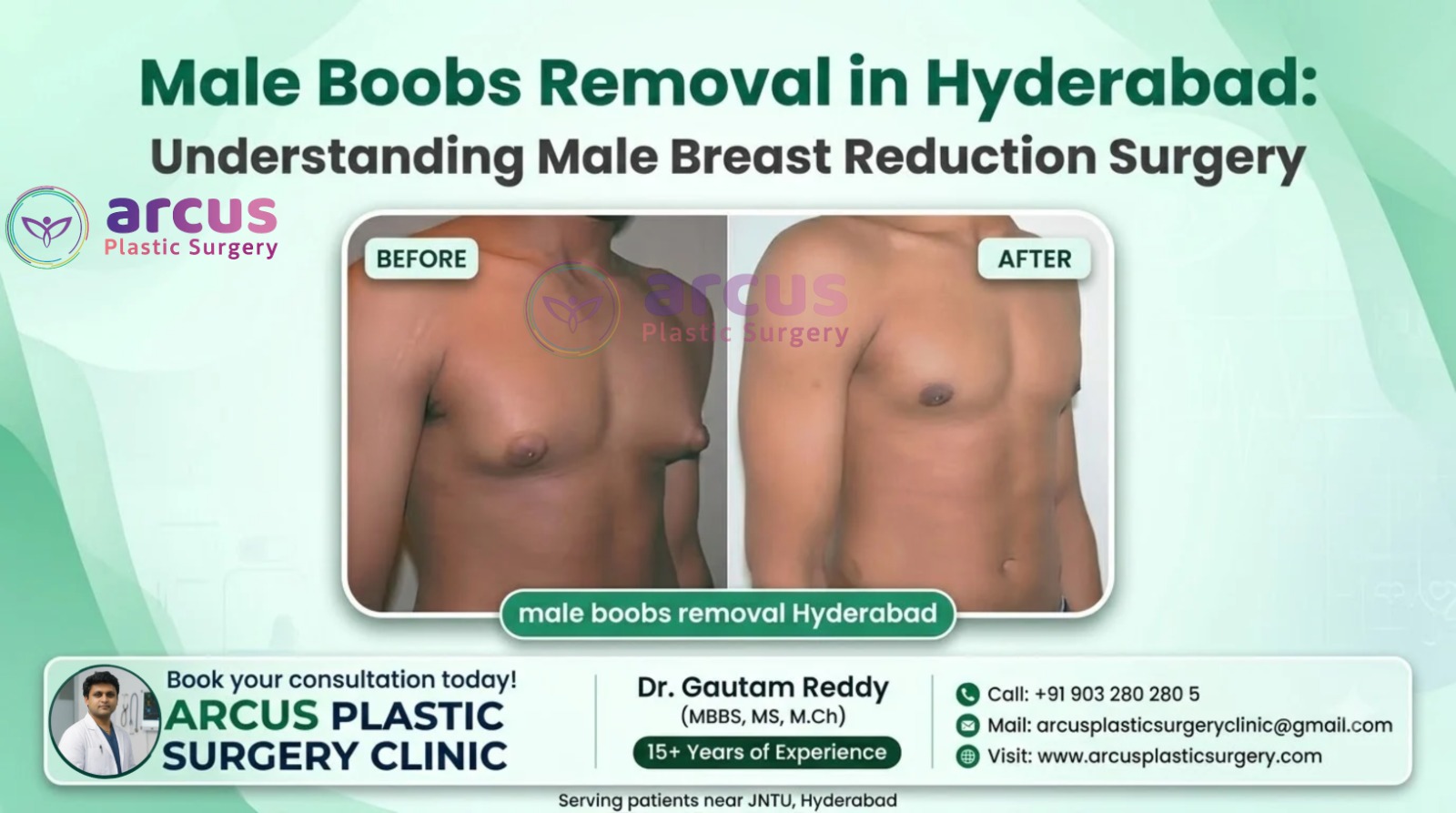
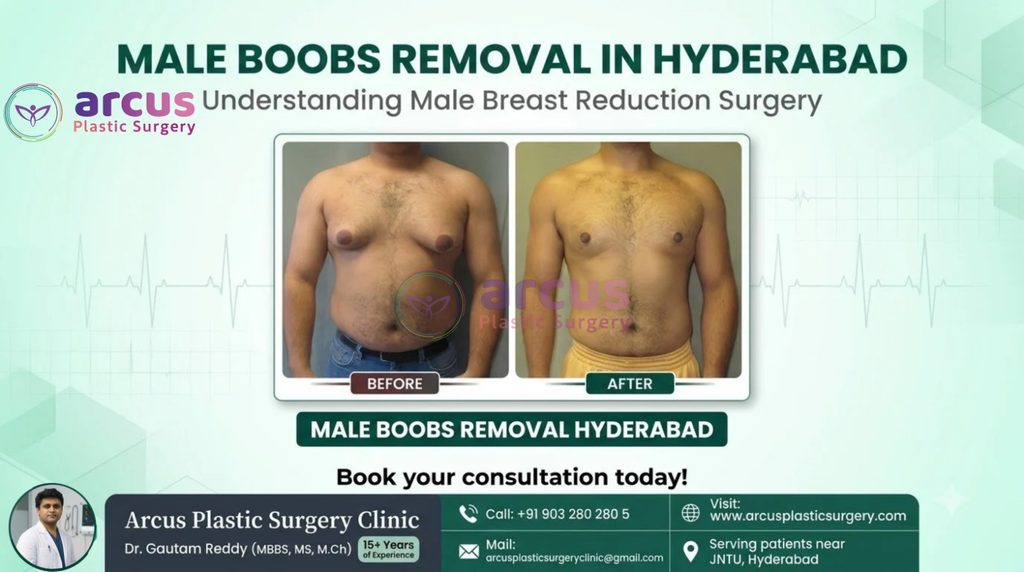
Before-and-after photographs may help patients understand possible changes, but they should be viewed as examples rather than promises. A surgeon should explain what is realistic for the individual patient.
Choosing a surgeon in Hyderabad
When researching man boobs removal Hyderabad, look beyond marketing language. Check the surgeon’s recognised specialist qualifications and experience, ask where the operation will be performed, and understand the arrangements for anaesthesia and post-operative monitoring.
It is also reasonable to ask how complications are handled, what follow-up is included, whether revision surgery may ever be necessary, and what the full treatment cost covers. The consultation should feel informative and respectful rather than rushed or pressurised.
Arcus Plastic Surgery is based in Kukatpally, Hyderabad. Patients can use a consultation with Dr. Gautam Reddy to discuss their concerns, understand the likely cause of chest enlargement, and review the suitability of different treatment approaches.
Frequently asked questions
1. Is “man boobs removal” the same as gynecomastia surgery?
The terms are often used interchangeably online. Medically, treatment may involve removing glandular tissue, fat, or both, depending on the diagnosis.
2. Can losing weight eliminate the need for surgery?
It may help when chest enlargement is mainly fat-related. Weight loss does not reliably remove established glandular tissue, and some patients have both fat and glandular enlargement.
3. Is male breast reduction only for people with obesity?
No. Gynecomastia can affect men at different body weights. A lean person may have glandular tissue that remains prominent despite exercise.
4. Will the nipples look different after surgery?
Their appearance can change as the chest contour changes. The final result depends on the tissue removed, skin elasticity, nipple position, and healing. The surgeon should discuss possible contour changes before surgery.
5. Are the results permanent?
Results can be long-lasting, but future weight gain, certain medications, anabolic steroids, or hormonal conditions can cause renewed fullness.
6. When can I return to the gym?
The timeline depends on the procedure and recovery. Your surgeon should confirm when light activity, upper-body exercise, and heavy lifting can safely resume.
7. Can surgery remove loose skin?
Excess skin can sometimes be removed, but this may require additional incisions and leave longer scars. The appropriate approach depends on the amount of skin and the patient’s priorities.
Conclusion
An enlarged male chest can have several causes, and the right approach begins with identifying the tissue involved. Exercise and weight management may improve fat-related fullness, while persistent glandular enlargement may require a different treatment. Patients should understand the possible benefits, risks, scars, and recovery requirements before deciding on surgery.
For those considering male breast reduction in Hyderabad, Arcus Plastic Surgery offers a place to discuss these concerns with Dr. Gautam Reddy. An individual assessment can help determine whether observation, medical evaluation, liposuction, glandular tissue removal, or a combination is appropriate.