
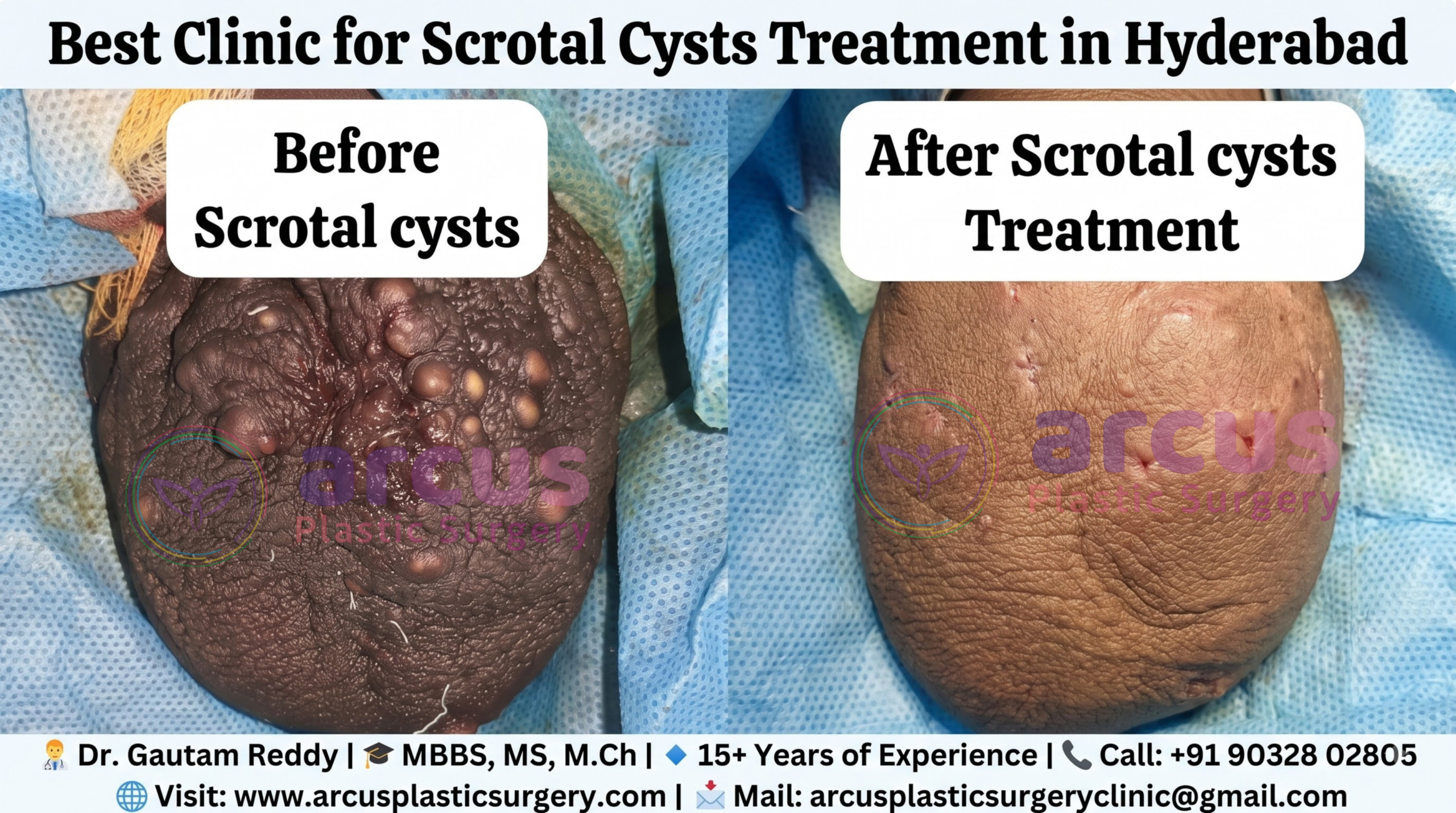
Best Clinic for Scrotal Cysts Treatment in HyderabadCall: 90328 02805Let's start with something simple: if you've found a lump and you're scared, that fear is normal, and it's almost always bigger than the actual problem.Every week, men walk into clinics across Hyderabad having convinced themselves of the worst-case scenario after finding a small swelling near …
Best Clinic for Scrotal Cysts Treatment in Hyderabad
Call: 90328 02805
Let’s start with something simple: if you’ve found a lump and you’re scared, that fear is normal, and it’s almost always bigger than the actual problem.
Every week, men walk into clinics across Hyderabad having convinced themselves of the worst-case scenario after finding a small swelling near the testicle. As a surgeon, I can tell you plainly — the overwhelming majority of these turn out to be scrotal cysts, and they’re one of the most manageable conditions we treat. If you’re searching for the best clinic for scrotal cysts treatment in Hyderabad, you’re already doing the right thing by looking for proper medical guidance instead of self-diagnosing off the internet.
Best Clinic For Scrotal Cysts Surgery In Hyderabad
Once treatment becomes necessary, the next natural step is finding the Best Clinic For Scrotal Cysts Surgery In Hyderabad — because while the condition itself is common, the way it’s handled varies a lot between clinics. Some rush you toward surgery. Others take time to explain what’s actually going on. That difference matters more than people realize going in.
What Is a Scrotal Cyst, in Plain Terms
A scrotal cyst is a small pouch of fluid that forms in or around the scrotum, usually near the tube that carries sperm from the testicle. Think of it like a tiny, harmless blister under the skin — except it’s inside the scrotal sac rather than on the surface.
Most scrotal cysts share a few common traits:
- Smooth, round, and easy to feel as a distinct lump
- Painless in the majority of cases
- Movable, not fixed to surrounding tissue
- Slow-growing, sometimes taking months or years to become noticeable
None of this means you should skip a proper exam. It just means panic isn’t the right first response.
Why They Happen
Medically, we can’t always point to one exact cause. But several factors commonly contribute:
- Minor blockages in the small ducts near the testicle
- Past inflammation or infection in the area
- Mild trauma, even something you don’t remember happening
- Natural tissue changes that come with age
None of these stem from anything a patient did wrong. That’s a question I get in almost every consultation, and the answer is always the same — this isn’t your fault.
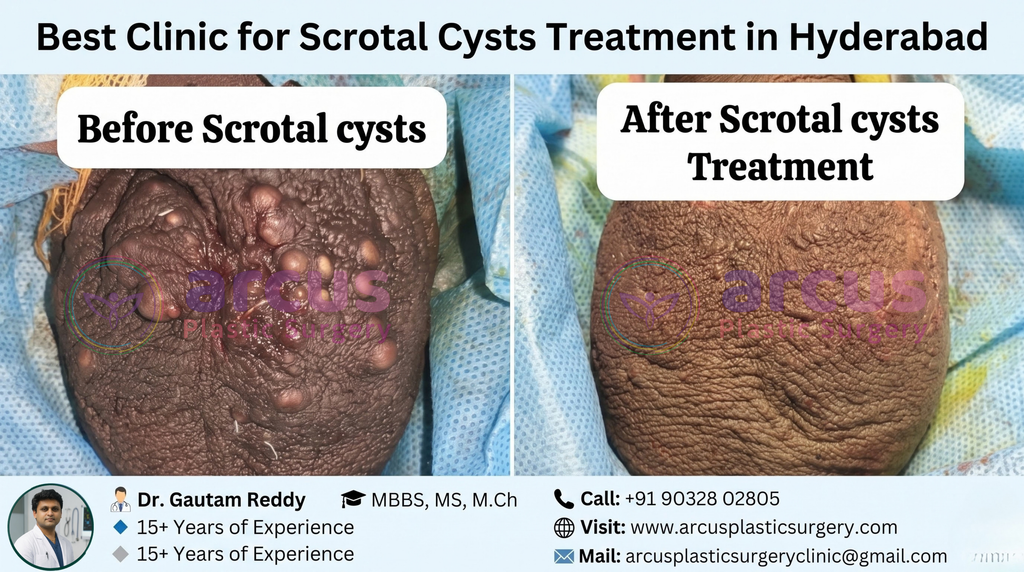
When You Should Actually See a Doctor
Here’s the honest clinical guidance I give patients:
- Any new lump — even painless ones deserve an exam, since a physical check and ultrasound are the only reliable ways to confirm what you’re dealing with.
- Pain, heaviness, or dragging sensation — especially if it worsens through the day.
- Sudden growth — a cyst that changes size quickly needs prompt evaluation.
- Redness, warmth, or fever alongside the lump — this points toward infection, not a simple cyst, and needs urgent attention.
How We Diagnose It
Diagnosis is usually quick, painless and much simpler than most patients expect. Most cases are confirmed in a single visit, using three straightforward steps.
1. Physical Examination
Your doctor gently examines the scrotum to check the size of the swelling, how it feels (soft, smooth or firm), and whether it moves or changes position. Tenderness and any signs of infection or hernia are also checked. This step alone gives a lot of useful information.
2. Scrotal Ultrasound
A scrotal ultrasound uses sound waves to create a clear image of the area. It is painless and involves no radiation. It confirms that the swelling is filled with fluid and not a solid mass, and it lets the doctor check the testicle itself for any other problem.
3. Transillumination Test
In this simple bedside test, a small light is held against the scrotum in a dimmed room. Fluid lets the light pass through and the area appears to glow, while solid tissue blocks it. It gives a quick, useful indication of what is causing the swelling.
Together, these steps give an accurate diagnosis without lengthy or invasive testing, so you can move on to the right treatment sooner.
Treatment: What Actually Happens Next
Many patients assume that a scrotal cyst means surgery. That is not the case. The right approach depends on the cyst’s size, your symptoms, and how it behaves over time, and there are three main options.
1. Watchful Waiting
If the cyst is small and causes no pain or discomfort, the safest choice is often to leave it alone and monitor it. You will have periodic check-ups, sometimes with a repeat ultrasound, to make sure it is not growing or changing. Many cysts stay the same size for years, and a large number never need any treatment.
2. Aspiration
If the cyst causes mild discomfort or a feeling of heaviness, the doctor can draw out the fluid with a fine needle. It is a quick outpatient procedure, and you can usually return to normal activities soon after. The trade-off is that the fluid can build up again over time, so this option gives relief but is not always a permanent fix.
3. Surgical Removal (Spermatocelectomy)
When a cyst is large, painful, or keeps coming back, surgical removal is the most reliable long-term solution. It is a minor procedure, usually done under local anaesthesia, and most patients go home the same day. Recovery is generally smooth, with some mild soreness or swelling for a few days.
The bottom line: treatment is tailored to you, and surgery is only recommended when it is truly needed. Your doctor will explain each option so you can choose with confidence..
What Recovery Looks Like
Patients are consistently surprised by how uneventful recovery tends to be:
- Mild soreness for two to three days, controlled with standard pain relief
- Supportive underwear recommended for comfort during healing
- Light activity resumes within a week
- Strenuous activity and intimacy typically avoided for two to three weeks
- Stitches, if used, dissolve or are removed within 7–10 days
Why Clinic Choice Matters More Than People Assume
This is a sensitive area of the body, and how a clinic handles that sensitivity affects the entire experience.
I look for — and recommend patients look for — a few specific things in any clinic offering scrotal cyst care:
- Genuine discretion. Consultations should feel private, never rushed or exposed.
- Focused surgical experience. Minor urological procedures require precision that general practice doesn’t always provide.
- Straightforward communication. No jargon, no vague reassurance — clear answers to direct questions.
- Real aftercare instructions, tailored to your case, not a generic handout.
Clearing Up a Few Persistent Myths
“It’s probably cancer.” In the vast majority of cases, it isn’t. Fluid-filled cysts behave very differently from solid masses on ultrasound, and that distinction alone rules out most serious concerns quickly.
“It’ll affect my fertility.” For the majority of patients, no. The cyst itself and its treatment are localized and don’t typically interfere with sperm production.
“Surgery means a big scar.” Modern minor surgical technique for this procedure leaves minimal, well-concealed scarring in nearly every case.
Where We Fit In
At Arcus Plastic Surgery in Kukatpally, Hyderabad — opposite Ankura Hospital on the JNTU–HiTech City Main Road — Dr. Gautam Reddy and the team approach scrotal cyst cases with exactly this philosophy: proper diagnosis first, clear explanation of every option, and treatment only when it’s genuinely needed rather than by default. If surgery is the right call, the focus stays on precision, minimal scarring, and a recovery process you actually understand from day one.
The Bottom Line
A scrotal cyst is one of the more straightforward conditions in urology and minor surgery. It’s common, it’s usually benign, and in most cases, it’s very manageable once properly diagnosed. If you’ve found a lump, the right next step isn’t more searching — it’s a short, private consultation that gives you real answers.
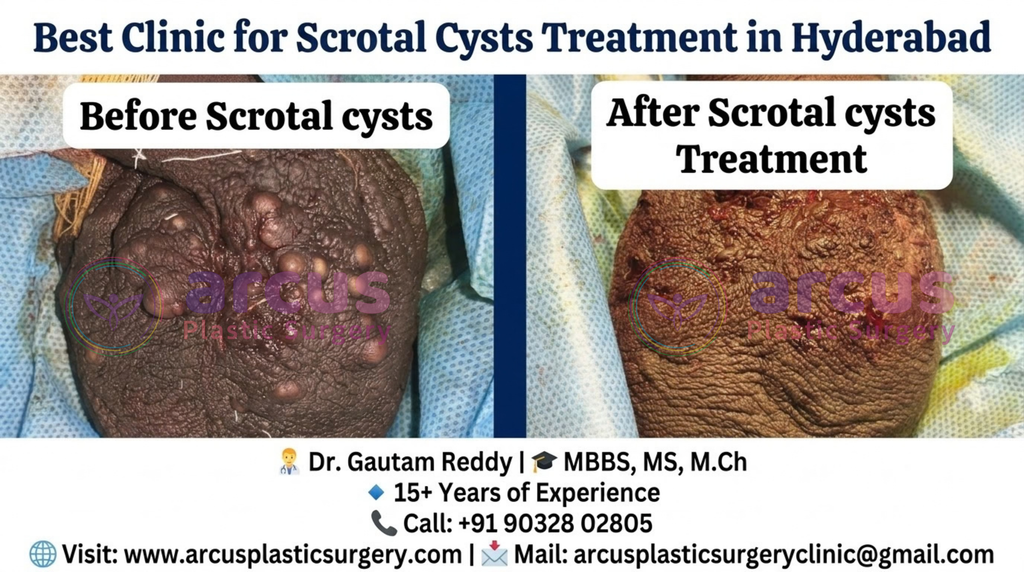
Frequently Asked Questions
1. Is a scrotal cyst dangerous?
In most cases, no. Scrotal cysts are typically benign and fluid-filled, and a proper exam confirms this quickly.
2. Does every scrotal cyst require surgery?
No. Many small, symptom-free cysts are simply monitored. Surgery is reserved for cysts that are large, painful, or persistently recurring.
3. Will treatment affect my fertility?
In the majority of cases, no. Treatment is localized and generally doesn’t interfere with sperm production.
4. How long is recovery after surgical removal?
Most patients return to normal activity within a week, with strenuous activity resuming after two to three weeks.
5. Can a scrotal cyst return after treatment?
Aspiration alone carries a higher chance of fluid reaccumulating. Surgical removal is more definitive with a lower recurrence rate.
6. Is the diagnostic process painful?
No. A physical exam and ultrasound are quick, non-invasive, and usually sufficient to confirm a diagnosis in one visit.